
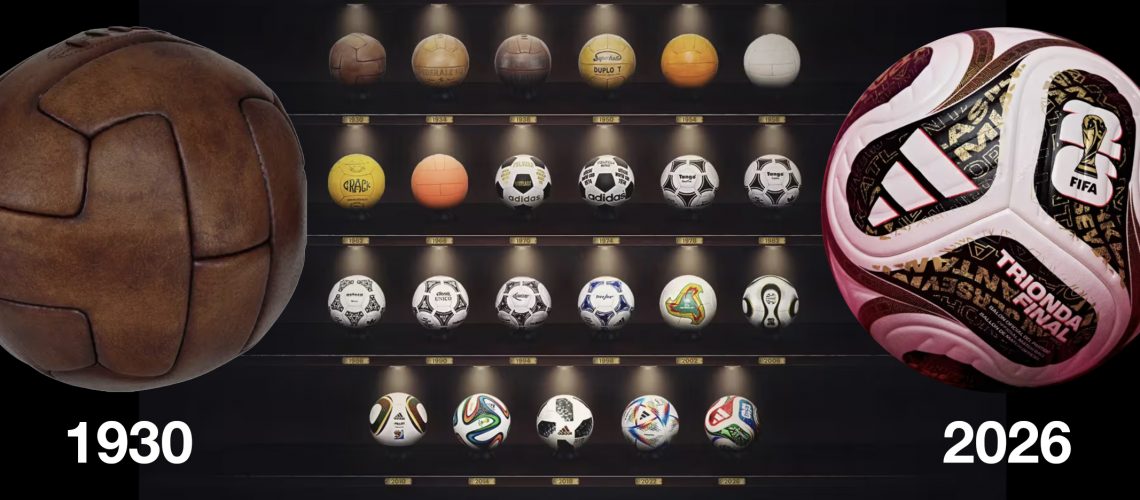
Every four years, the FIFA World Cup introduces a new match ball. While changes in color and graphics often receive the most attention, the true story lies beneath the surface. Each ball represents a different approach to geometry, materials science, and aerodynamics, reflecting decades of experimentation with how a soccer ball should move through the air.
For much of the twentieth century, soccer balls followed a familiar pattern: a combination of 12 pentagons and 20 hexagons stitched together to form a shape known as a truncated icosahedron. This is the traditional black and white ball your five-year-old likes to kick around. Popularized by the 1970 Telstar, this 32-panel design created a nearly spherical ball while maintaining predictable flight characteristics.
As manufacturing techniques improved, designers began reducing the number of panels. Fewer seams meant a smoother surface, greater water resistance, and more consistency from ball to ball. The 2006 Teamgeist used just 14 panels, while the 2010 Jabulani featured eight thermally bonded panels. These changes were not merely aesthetic. The seams on a soccer ball create turbulence that affects how air flows around it. Altering the number, depth, and shape of those seams changes drag, lift, and stability in flight.
The Jabulani became particularly famous because many players felt it moved unpredictably through the air. Researchers later found that its smoother surface produced different aerodynamic behavior than previous designs, especially at higher speeds. In response, subsequent World Cup balls incorporated new textures and panel configurations intended to balance speed with control.
This year’s signature ball, called the Adidas Tionda, features a seamless, thermal-bonded four-panel design with specialized PRISMA surface debossing. Graphically its colors reflects the selected imagery for each of the three host nations.
The evolution of the World Cup ball demonstrates how design often exists at the intersection of art and engineering. A few adjustments to shape, panel geometry, or surface texture can influence how the game is played on the world’s biggest stage. What appears to be a simple sphere is, in reality, a carefully engineered object whose design decisions are measured in fractions of inches and fractions of seconds.